



 Finance
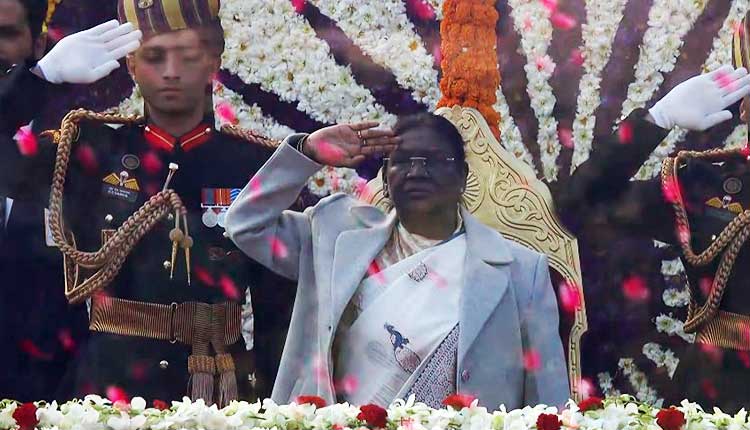
The Indian Air Force’s fighter jets flew in a distinctive Sindoor configuration during the 77th Republic Day flypast on Monday, demonstrating India’s air power.
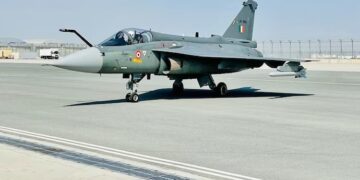
Officials said the formidable seven-plane formation included two Rafales, two Su-30s, two MiG-29s, and a Jaguar aircraft.
This year marks the first Republic Day since Operation Sindoor, which demonstrated India’s military power. On May 7, 2025, India began Operation Sindoor, in which the IAF and Indian Army engaged out attacks within Pakistan to demolish militant infrastructure following the Pahalgam assault in April that year.
According to a report, India’s military assets marched down the Kartavya Path in a sequence similar to that of an actual war, beginning with reconnaissance and progressing to other military units such as logistics and people following these platforms while donning battle gear.
During the Republic Day parade in New Delhi, which began at 10:30 a.m. today, a total of 30 tableaux rolled down the Kartavya Path, with 17 representing states/union territories and 13 representing ministries/departments/services.
What did the Op Sindoor flypast include?
This year’s R-Day Parade featured several formations dedicated to the operation’s accomplishment. These included the “Prahar Formation, the Garud Formation, and a powerful, dedicated formation known as the Sindoor Formation,” Wing Commander Rajesh Deshwal told the reporters on Thursday.
In time with the marching contingent, two Rafale planes, two MiG-29s, two Su-30s, and one Jaguar aircraft flew in ‘Spearhead’ configuration, symbolizing the “Sindoor Formation.”
verall, a total of 29 aircraft participated in the flypast this year, including 16 fighter aircraft, four transport aircraft, and nine helicopters from six different bases.
Prahar & Garud Formations: It comprises of three Advanced Light Helicopters (ALH) — two from the Indian Army and one from the Indian Air Force — of which the lead aircraft will carry the Operation Sindoor flag, the Commander told the press. It will be followed by the Garud Formation, and both will fly in a battle array format, he added.
Sindoor Formation: It comprises two Rafale aircraft, MiG-29 aircraft and Su-30 MKI aircraft each besides one Jaguar aircraft, making it a powerful seven-aircraft formation, he said.
The flypast commenced with Dhwaj formation, where four Mi-17 IV helicopters carried the National Flag alongside the flags of the three services.
The formations were complemented by strategic assets including the “C-130 and C-295, as well as the Indian Navy’s P-8i aircraft. Attack helicopters, such as the IAF’s ALH MK IV and the Indian Army’s ALH WSI, Apache and Light Combat Helicopter (LCH) will also participate in the flypast showcasing jointmanship,” according to an official statement.
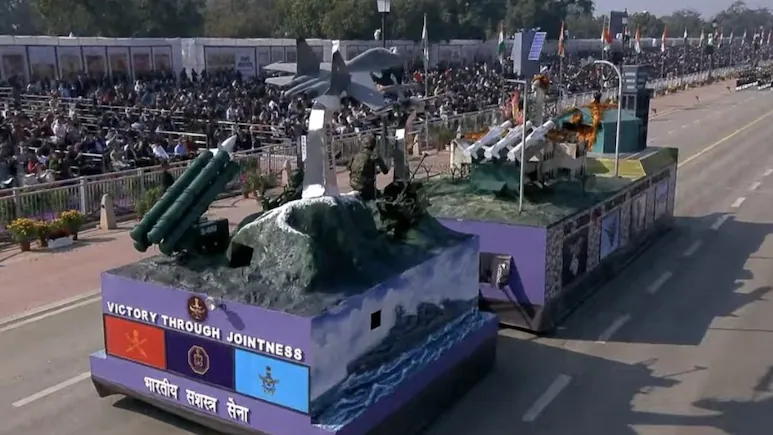
Tri-services tableau with weapons as deployed during Op Sindoor
A tri-services tableau displaying replicas of India’s primary weapon systems used by the country’s military during Operation Sindoor in early May remained a popular draw.
Additionally, a glass-enclosed integrated operating center depicting the operation’s usage of weapons systems such as BrahMos and S-400 missiles rolled along the Kartavya path.
For the first time, the parade used the Indian Army’s phased ‘Battle Array Format’, which included an aerial component. According to PTI, it included India’s first indigenously manufactured armoured light specialized vehicle as well as a high mobility reconnaissance vehicle.
The indigenous Dhruv Advanced Light Helicopter and its armed version, Rudra, in Prahar formation, demonstrated shaping of the battlefield during the Operation.
Veteran tableau
A “veteran’s tableau” was also on display at the parade, with the front portion featuring the Amar Jawan Jyoti, 3D models of historical war machines such as the T-55 and Vijayant Tank, Hunter, MiG-21, Mirage, and Jaguar aircraft, INS Mysore and INS Rajput, and representations from the 1965, 1971, and 1999 Kargil Operation Vijay.
According to the PTI report, the primary weapon systems displayed during today’s parade included the Suryastra Universal Rocket Launcher System (URLS), Brahmos Supersonic cruise missiles, and Akash missile systems.
Naval tableau
The Defence Research & Development Organisation (DRDO) demonstrated some of its exceptional innovations for national security during the parade and Bharat Parv 2026, including the Long Range Anti-Ship Hypersonic Missile (LR-AShM) and the DRDO Tableau-‘Naval Technologies for Combat Submarines,” according to a Ministry of Defence statement.
The LR-AShM is a hypersonic glide missile capable of engaging both stationary and moving targets. It is the first of its sort, with indigenous avionics technology and high-accuracy sensor packages.
The tableau displayed indigenously developed technologies and systems that served as a force multiplier for the Indian Navy’s conventional submarines, according to the statement. These systems include the Integrated Combat Suite (ICS), Wire Guided Heavy Weight Torpedo (WGHWT), and Air Independent Propulsion, which will ensure combat supremacy in the underwater domain.
Source: IE