




 Finance
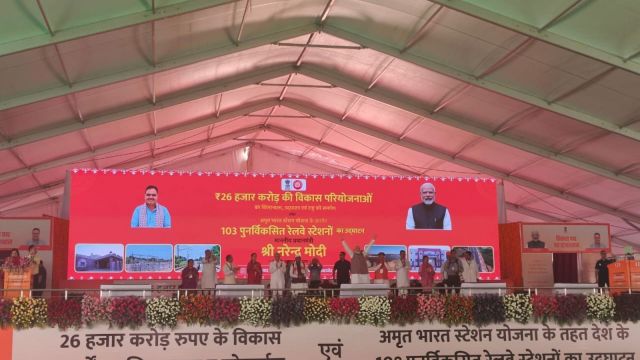
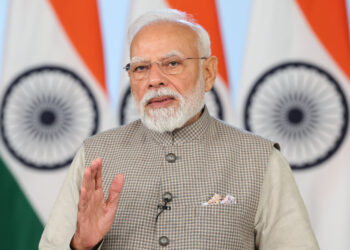
Prime Minister Narendra Modi inaugurated 103 renovated railway stations in 86 districts across 18 states and union territories on Thursday as part of the Amrit Bharat Station Scheme. He also launched a new weekly train between Bandra Terminus in Mumbai and Bikaner Station in Rajasthan.
PM Modi opened the renovated Deshnoke railway station after praying at the Karni Mata shrine in Deshnoke, some 30 kilometers from Bikaner and approximately 200 kilometers from Pakistan’s international border. He also virtually inaugurated 102 additional stations.
Of the 103 stations redeveloped at a cost of over Rs 1,100 crore, 19 are in Uttar Pradesh, 18 in Gujarat, 15 in Maharashtra, nine in Tamil Nadu, eight in Rajasthan, six in Madhya Pradesh, five each in Chhattisgarh and Karnataka, three each in Jharkhand, Telangana and West Bengal, two each in Bihar and Kerala and one each in Andhra Pradesh, Assam, Haryana, Himachal Pradesh, and Puducherry.
A total of 1,300 stations have been identified for redevelopment under the scheme. Out of these, 157 are in Uttar Pradesh, followed by 132 in Maharashtra and 101 in West Bengal.
The Amrit Bharat Station Scheme, which began in 2022, is a long-term strategy to upgrade railway stations and transform them into “city centres.” According to the Ministry of Railways, the concept involves creating detailed plans for each station and carrying out the work in phases based on the needs of each station.
Deshnoke railway station, which serves pilgrims and visitors visiting the Karni Mata Temple, is one of the stations refurbished under the program and was largely inspired by temple architecture. Begumpet railway station in Telangana has design elements influenced by Kakatiya empire architecture, whilst Thawe station in Bihar features murals and artwork depicting Madhubani painting. Ranchhodrai Ji Maharaj served as the inspiration for Dakor station in Gujarat.
The rebuilt stations include access and exit points, waiting halls, restrooms, platforms, and roofing. In addition, lifts, escalators, and free Wi-Fi are installed as needed. There are also improved signage and information systems to assist passengers. Some stations will feature executive lounges and designated rooms for business meetings. The ‘One Station, One Product’ initiative will see local products marketed at kiosks.
Previously, six stations were reconstructed under the Amrit Bharat Station Scheme: MP’s Rani Kamlapati, Gujarat’s Gandhinagar Capital, Karnataka’s Sir M V Terminal, Uttar Pradesh’s Ayodhya Dham, the first phase of the Gomti Nagar railway station, and the second entry of Odisha’s Cuttack station. Many of these were pilot programs for the scheme.
According to railway ministry data, nearly Rs 8,000 crore was spent on ‘customer amenities’ in 2023-24. The estimated expenditure objective for the fiscal year 2024-25 was Rs 12,992 crore, with more than Rs 12,000 crore allotted for FY 2025-26.
PM Modi also inaugurated many completed electrification projects, including the Suratgarh-Phalodi rail line (336 route kilometers, or Rkm), the Phulera-Degana rail line (109 Rkm), the Udaipur-Himmatnagar rail line (210 Rkm), the Phalodi-Jaisalmer rail line (157 Rkm), and the Samdari-Barmer rail line (129 Rkm). He also set the groundwork for the doubling of the Churu-Sadulpur railway line (58 kilometers).
Source: IE