




 Finance
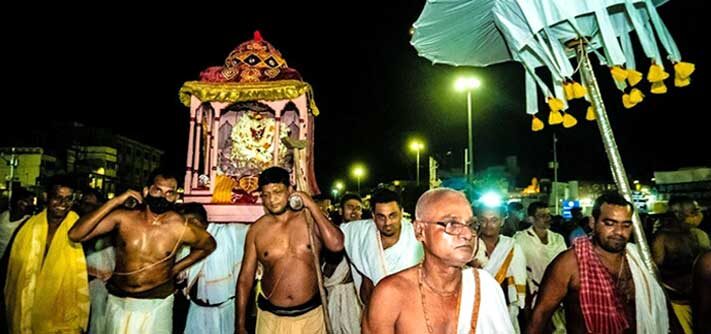
Hera Panchami is the fifth day of Asadha Shukla Panchami Tithi. The devotees enter at the Singha Dwara and go by the Nakachana Dwara.
Hera Panchami is a significant event in Rath Yatra because Goddess Lakshmi, the Lord’s wife, will break His chariot. According to mythology, Lord Jagannath and his brothers are on their way to Saradhabali to visit their maternal aunts. However, the Lords did not accompany Maa Lakshmi.
Hera Panchami is a gripping ritual in which Goddess Lakshmi vents her rage against her husband, Lord Jagannath, as he begins on a nine-day journey to Gundicha temple with his siblings.
Lord Jagannath is so busy visiting His devotees and spending time with His siblings at His aunt’s house that He forgets about Goodness and returns late to Srimandir.
The Hera Panchami ceremony enacts the divine drama of celestial deities. Goddess Lakshmi’s wrath falls on Lord Jagannath as she unleashes her rage, her anger blazing like a thousand suns.
According to the ceremony, Lord Jagannath’s holy expedition with his siblings, Balabhadra and Subhadra, leaves his consort, Goddess Lakshmi, nervously waiting in the Srimandir. Her patience runs thin as the days pass, and Lord Jagannath fails to appear, absorbed in holy joy with followers. The goddess’ longing transforms into rage, and she decides to take matters into her own hands.
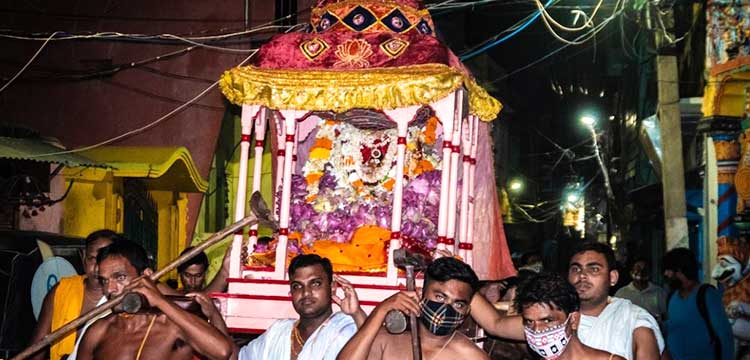
Goddess Lakshmi sets out in a grand procession to the Gundicha Temple, her palanquin borne by temple servitors, to confront her beloved husband. Upon arrival, she unleashes her wrath upon Lord Jagannath’s chariot, Nandighosha, ordering her servitors to damage a part of it as a symbol of her displeasure. This dramatic display of divine emotions showcases the complex dynamics of their celestial relationship.
“Goddess Lakhmi comes out of the Srimandir in a palanquin amid a grand procession on Bada Danda and reaches the Nandighosh chariot in front of the Gundicha temple. But unable to meet her husband, she damages the Nandighosh rath out of anger,” said a servitor Kumar Bhimsen.
The Evolution of Hera Panchami
According to the ancient records of ‘Ratha Chakada’, King Kapilendra Deb transformed the Hera Panchami ritual from a simple chanting ceremony into a big and grandiose festival. Since his reign, this ceremony has been an essential component of the Rath Yatra celebration. Significantly, Hera Panchami marks the start of the Bahuda Jatra, during which the three chariots are ceremoniously turned southward, known as Dakhina Moda, to herald the deities’ return voyage.
Around 129 years ago, Odisha’s pioneering vernacular daily, Utkal Deepika, published the first article on Hera Panchami, bringing light on this important component of Odia tradition. On July 28, 1888, a new era in the coverage of Odisha’s rich legacy began.
Jagannath Researcher’s Perspective on Hera Panchami
According to Trilochan Mishra, a well-known Jagannath culture expert, the Hera Panchami rite perfectly depicts the core of an Odia wife’s emotions. Goddess Maha Lakshmi’s grief as Lord Jagannath goes on his annual voyage with his siblings represents a wife’s universal need for her husband’s presence.
Mishra emphasizes that the celestial marriage of Lord Jagannath and Goddess Maha Lakshmi occurs on Jyeshtha Sukla Ekadasi. However, Lord Jagannath’s departure for his annual vacation without alerting his wife irritates her, reflecting the sentiments of a newlywed woman.
He further adds: “It is when Goddess Bimala comes to the rescue of Goddess Lakhmi when the latter’s husband does not come back even after four nights. Maa Bimala, who is considered the Tantric consort of Jagannath and a guardian of Srimandir, gives Goddess Lakshmi ‘Mohana Churna’ (a powder to attract husband) for Lord Jagannath’s early return, saying ‘Aou Dukha Na Kara Go Bishnu nka Gharani, Mohechurna Basibhuta Hebe Tha Jani’.
“Following God Brahma’s reminder, Goddess Lakshmi makes her way to the Gundicha temple, where Lord Jagannath resides with his siblings. Brahma has once said, ‘A single glance at Lord Jagannath at Adapa Mandap is equivalent to a hundred darshans at Ratna Mandap’. Brahma’s words prompt her to visit her husband at Adapa Mandap. In the evening, a grand procession makes its way along the Bada Danda, as servitors carry Goddess Lakshmi in a decorated palanquin, accompanied by great fanfare and jubilation, to the Gundicha temple, where she will finally be reunited with Lord Jagannath”, maintained the researcher.
He further said, “The procession of Goddess Lakshmi comes to a halt near the Nandighosha Ratha, the chariot of Lord Jagannath, where she is greeted with ceremonial offerings. She enters the Gundicha temple, throws the ‘Mohana Churna’ to attract her husband, and receives a garland of consent (‘Agyan Mala’) on behalf of Lord Jagannath. However, feeling neglected and angry due to her husband’s indifference, she orders her servitors to damage a part of his chariot, seeking to teach him a lesson. Later, overcome with guilt for causing harm to the sacred Nandighosha, she secretly returns to Srimandira, abandoning her procession and fanfare, and humbly makes her way back through Hera Gohiri Sahi.”