





 Finance
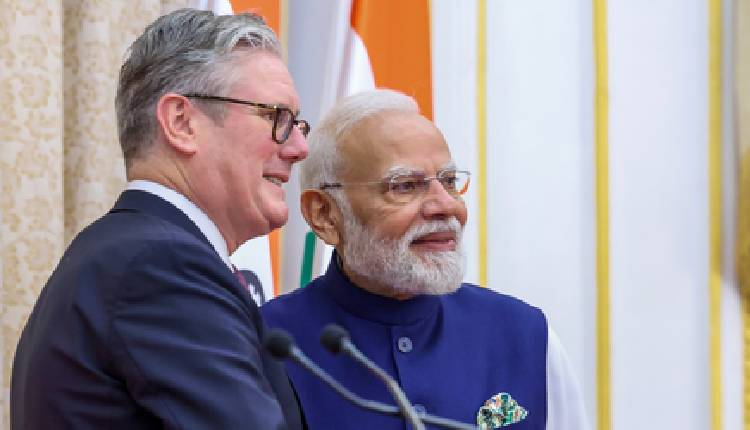
The India-UK free trade deal is expected to go into effect in April of this year, paving the way for an increase in Indian exports to the European country, according to a top official on Sunday.
The two countries inked the deal in July of last year, and it now needs to be approved by the UK Parliament before it can take effect.
The process has already begun, with debate on the Free Trade Agreement (FTA) taking place in both Houses of the British Parliament.
“Under the free trade agreement, 99 per cent of Indian exports to the UK will get the benefit of zero duty. This opens up massive export opportunities for labour-intensive sectors such as textiles, marine products, leather, footwear, sports goods and toys, gems and jewellery, and other important sectors such as engineering goods, auto parts and engines, and organic chemicals,” according to an official statement.
Furthermore, India has ensured that non-tariff obstacles are appropriately handled to ensure the free movement of products and services and do not impose unwarranted limits on India’s exports.
In May of last year, Prime Minister Narendra Modi and his British counterpart Keir Starmer hailed the successful conclusion of the mutually beneficial India-UK free trade agreement.
The agreement was reached when PM Modi spoke with the UK Prime Minister on the phone.
Aside from the FTA, a Double Contribution Convention has been struck to protect the interests of Indian workers in the UK.
Trade in services, such as information technology/information technology enabled services, financial services, professional services, other business services, and educational services, will also experience significant growth.
India has also obtained a three-year exemption from paying social security contributions in the UK for Indian workers who are temporarily in the country, as well as their employers, under the Double Contribution Convention.
This will greatly increase Indian service providers’ competitiveness in the UK.
Under the agreement, Scotch whisky taxes will be decreased from 150 percent to 75 percent, and then to 40 percent by 2035.
India would also gradually reduce import levies on autos from up to 110% to 10% over a five-year period under a quota system. In exchange, Indian manufacturers will gain market access in the UK for electric and hybrid vehicles under a quota system.
The FTA takes place against the backdrop of rising economic links between India and the UK, as seen by bilateral trade of approximately $60 billion, which is expected to quadruple by 2030.
Source: IANS