






 Finance
Prime Minister Narendra Modi has made a significant contribution to India’s telecom industry by simultaneously introducing BSNL’s 4G services nationwide. The state-run operator has activated its network over 98,000 sites, providing high-speed internet to subscribers in all states. With this launch, BSNL joins private telecom providers in providing pan-India 4G connectivity.
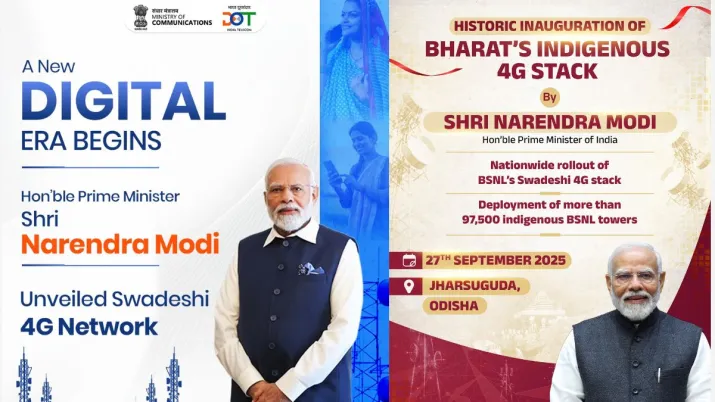
98,000 Mobile towers installed
The announcement was made in Jharsuguda, Odisha, where Prime Minister Modi also unveiled numerous other projects. On September 26, BSNL celebrated its 25th anniversary, and Union Communications Minister Jyotiraditya Scindia announced the successful deployment of 98,000 4G/5G mobile towers. He also stated that 100,000 additional towers would be built in the near future to improve connection even further.
Indigenous technology powers BSNL 4G
Unlike private networks, BSNL’s 4G is built entirely on indigenous technology, with both software and hardware developed in India. This achievement places India among the top five countries worldwide—alongside Sweden, Denmark, China, and South Korea—that have developed self-reliant telecom infrastructure. The government has invested ₹37,000 crore in building this robust, homegrown network.
Benefits for users and competitive pricing
The introduction of BSNL 4G is estimated to help over 90 million subscribers immediately. BSNL’s recharge prices are 30 to 40% cheaper than private operators, giving it an appealing option for those who had previously switched owing to network issues. With better coverage and quicker speeds, the state-owned operator hopes to rebuild consumer trust and potentially attract number portability from private competitors.
Roadmap for 5G and 6G in India
BSNL is also preparing for its 5G rollout, which could begin by the end of this year in metro cities like Delhi and Mumbai. Beyond 5G, PM Modi emphasised India’s readiness for 6G technology, with the government targeting a 2030 launch. If successful, India will be among the first countries to offer 6G services.
TCS and Tejas Networks’ contribution
The network rollout has been supported by Tata Consultancy Services (TCS), which handled integration, while Tejas Networks developed the radio access system. This collaboration has enabled BSNL to deliver a fully indigenous 4G solution, aligned with the vision of Atmanirbhar Bharat (self-reliant India).