


 Finance
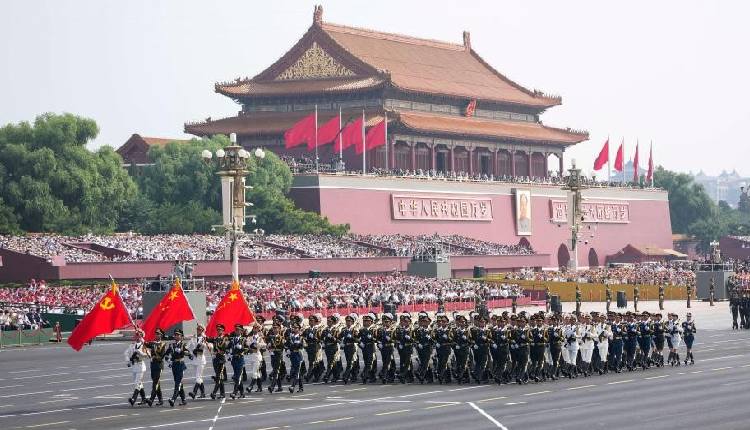
In a historic first, China revealed some of its most modern military technology, including hypersonic missiles, electronic warfare systems, and unmanned combat platforms, during a large military parade in downtown Beijing on Wednesday.
President Xi Jinping delivered a strong message of peace and international cooperation at the ceremony, which commemorated the 80th anniversary of China’s triumph in World War II. Global tensions remain high.
The parade, held in Tian’anmen Square, exhibited some of China’s most powerful weaponry, including hypersonic missiles, directed-energy systems, electronic warfare equipment, and unmanned intelligence platforms, all of which were shown to the public for the first time. More than 10,000 military men, over 100 planes, and hundreds of tanks and armored vehicles took part in the exercise.
The parade was overseen by President Xi Jinping, who also serves as the General Secretary of the Communist Party and Chairman of the Central Military Commission. In his keynote speech, Xi highlighted the historical significance of the victory, calling it “China’s first complete triumph against foreign aggression in modern times”.
“The Chinese people made a major contribution to the salvation of human civilisation and the defence of world peace,” Xi said, urging nations to “eliminate the root causes of war” and prevent the repetition of historical tragedies.
Over two dozen foreign leaders joined Xi on the Tian’anmen Rostrum, including Russian President Vladimir Putin, North Korean leader Kim Jong Un, and officials from Iran, Malaysia, Pakistan, Nepal, Maldives, Myanmar, Indonesia, Mongolia, Zimbabwe, and Central Asian countries.
This was only China’s second large-scale military parade since 2015 to commemorate Victory Day. Towering installations like the Great Wall stood in the square, symbolizing Chinese resilience during the conflict. As troops marched in perfect formations, helicopters carried banners reading “Justice Prevails”, “Peace Prevails”, and “The People Prevail”.
Spectators and veterans saw 80 commemoration flags recognizing key military groups from the battle.
China’s resistance, which began in 1931, was the earliest and longest among Allied nations, with the country tying up more than half of Japan’s foreign forces and incurring 35 million casualties, or about one-third of overall global losses in WWII.
Representatives from countries that assisted China throughout the war, such as the United States, the United Kingdom, France, Russia, and Canada, were also invited.
For the first time, Chinese peacekeepers, who served under the United Nations, were included in the formations, reflecting China’s growing global defence posture. A soldier who had served in the Democratic Republic of the Congo said, “We have the capability to defend the peace forged with the blood of our forefathers.”
Xi also emphasised that the People’s Liberation Army (PLA) must provide strategic support for China’s rejuvenation and modernisation, in line with the nation’s long-term goal to become a fully modern socialist country by 2035.
“Eighty years ago, we were revived. Eighty years later, we are thriving with even greater vitality,” said Lyu Shouye, a graduate student and spectator at the event.
Source: IANS