






 Finance

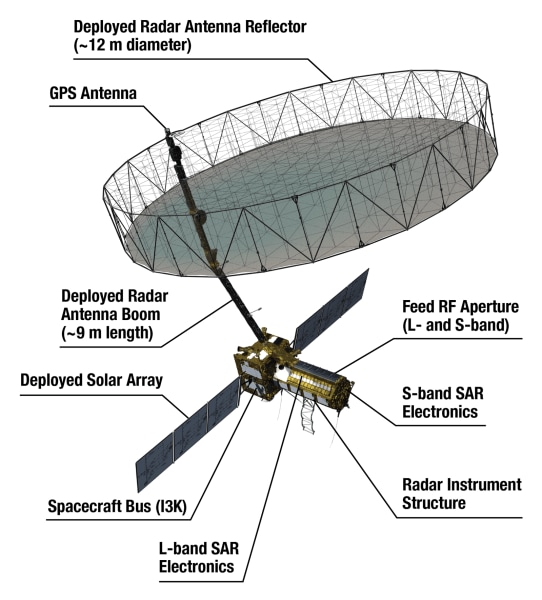
An important milestone in the satellite’s deployment phase has been reached with the successful “bloom” of the massive antenna reflector on the joint Isro-Nasa project, the earth observation satellite NISAR. NASA confirmed in a statement that the antenna deployment was successful, stating that the 39-foot-diameter antenna reflector had been unfurled step-by-step on Friday.
The first joint satellite of the Indian Space Research Organization (Isro) and the National Aeronautics and Space Administration (Nasa) of the United States is called NISAR (Nasa-Isro Synthetic Aperture Radar). NISAR, which cost $1.3 billion and weighed more than 2.8 tonnes, is the most costly earth observation satellite ever constructed.
NISAR was successfully placed into a sun-synchronous orbit after being launched by Isro on July 30 from the Satish Dhawan Space Centre in Sriharikota, Andhra Pradesh. The first-of-its-kind space project, NISAR, will investigate the solid, liquid, and frozen landforms of Earth. It is intended to monitor even the tiniest alterations in seas, soil moisture, ice sheets, glaciers, forest cover, earthquakes, and volcanic activity.
The world will be imaged once every twelve days by NISAR’s sophisticated twin radars. With the ability to see through clouds and provide all-weather imaging of the globe, the advanced radar systems on board combine two synthetic aperture radar (SAR) systems: an L-band system and an S-band system.
“From innovative technology to research and modeling to delivering science to help inform decisions, the data NISAR is poised to gather will have a major impact on how global communities and stakeholders improve infrastructure, prepare for and recover from natural disasters, and maintain food security,” said Karen St Germain, director, Earth Science Division at the Nasa headquarters.
The antenna and other satellite components are presently being fine-tuned by the NASA and ISRO teams.
NISAR will stay in its calibration and testing phase following the antenna’s deployment. The preliminary tests and calibration will be carried out during NISAR’s 65-day engineering phase. The first full-frame scientific data will be collected on day 65 (about early October), and the science teams will assess its quality and other factors.
The NISAR team has stated that the mission’s actual science phase will begin on day 70, which is provisionally scheduled for mid-October. Data will be made available for usage as soon as it is received in the required quality.
NISAR’s scientific commissioning phase is scheduled to begin on day 90, which is tentatively early November.
Source: IE