


 Finance
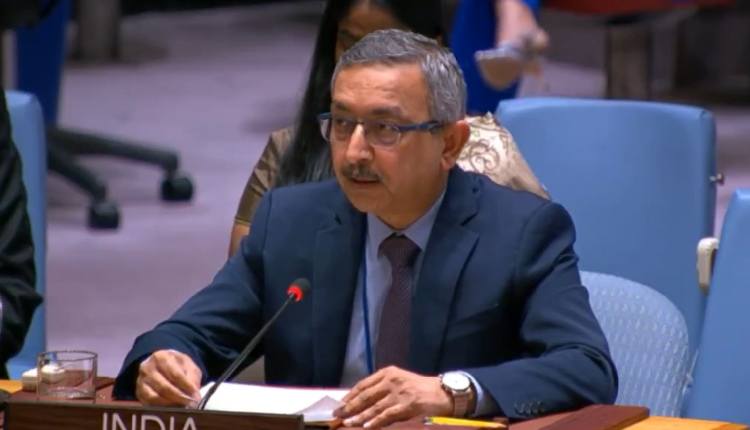
India made a strong commitment to a free, open, and rules-based maritime system that is founded on international law and guided by the principles of the United Nations Convention on the Law of the Sea (UNCLOS) during a high-level UN Security Council debate on maritime security that was conducted in New York.
Panama’s Permanent Mission convened the discussion, which brought together international parties to discuss urgent issues in maritime security and governance.
Prime Minister Narendra Modi’s vision for marine security, known as MAHASAGAR (Mutual and Holistic Advancement for Security and Growth Across Regions), was presented to the meeting by Tanmaya Lal, Secretary (West), Ministry of External Affairs (MEA).
Additionally, he congratulated Panama on assuming the UN Security Council Presidency in August.
Emphasising the critical importance of sea routes for global trade, energy supplies, communication cables, the traditional and non-traditional threats, and India’s longstanding maritime tradition, Lal stated that India, as one of the world’s largest economies, has strong stakes and interests in maritime security.
“India, with a coastline of more than 11,000 km and nearly 1,300 offshore islands and islets, has an Exclusive Economic Zone spread over nearly 2.3 million sq km. India shares maritime boundaries with 7 nations. There are 12 major ports, 200 smaller ports, and nearly 30 shipyards on the Indian coast, continuing the longstanding shipbuilding tradition. India is also the third largest supplier of seafarers to the global maritime industry,” he noted.
According to him, millions of Indians depend on the ocean economy for their livelihood, and a sizable portion of the population lives along the coast.
Lal emphasized the magnitude of India’s problems with marine safety and security, as well as the pressing significance of issues related to environmental sustainability and economic stability.
“India is a founding member of the Indian Ocean Rim Association (IORA) and Indian Ocean Naval Symposium (IONS), and is an observer at the Indian Ocean Commission (IOC). We also engage with a range of partners at other formats such as the Djibouti Code of Conduct (DCoC), Contact Group on Illicit Maritime Activities (CGIMA), and Bay of Bengal Initiative for Multisectoral Technical & Economic Cooperation (BIMSTEC),” the MEA official emphasised.
“Operational coordination is achieved through working groups and exercises like Coordinated Patrols (CORPATs), Africa-India Key Maritime Engagement (AIKEYME), ASEAN-India Maritime exercises, exercise MILAN hosted by India, IONS Chiefs Conclave and exercise Malabar. India and the EU have conducted joint naval activities in the Gulf of Guinea to reinforce maritime security,” he added.
Lal added that an Indian Naval ship, the Indian Ocean Ship (IOS) Sagar, recently cruised with about 50 crew members from nine partner nations in the Indian Ocean Region, conducting cooperative maritime security operations as part of a unique project.
According to Lal, India’s current Deep Ocean Mission would advance knowledge of deep-sea ecosystems, enabling the preservation of biodiversity and sustainable fishing practices.
As a responsible maritime power, India is prepared to continue supporting these collaborative efforts, he said, calling for true international cooperation to confront the shared challenges to marine security and prosperity.
Source: IANS