




 Finance
In the current uncertain environment, New Delhi is reshaping its diplomacy to serve a clear economic and strategic goal as the India-Singapore partnership grows stronger.
According to an article in India Narrative, Singapore is essential to India’s goal of fortifying its foreign economic policy with reliable, competent, and strategically located allies in the face of weak supply chains, unstable trade regulations, and climatic issues.
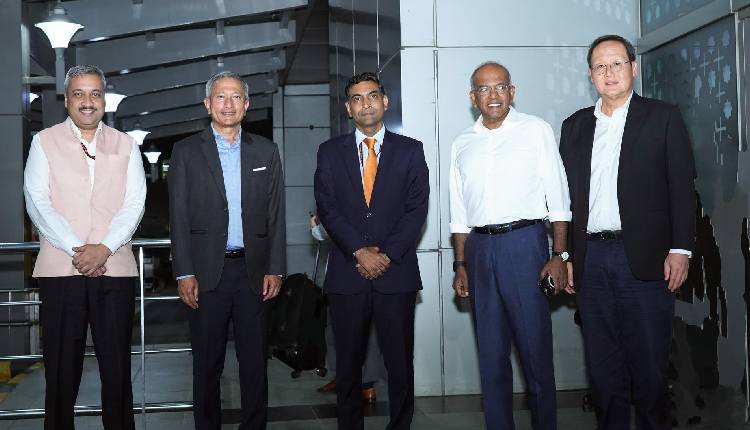
Here, the Third India-Singapore Ministerial Roundtable (ISMR) is set to provide new impetus. A high-level Singaporean team led by Deputy Prime Minister Gan Kim Yong and Foreign Affairs Minister Vivian Balakrishnan will attend the meeting alongside Indian ministers Dr. S. Jaishankar, Nirmala Sitharaman, Ashwini Vaishnaw, and Piyush Goyal. This unique forum, launched in 2022, is designed to chart the next phase of cooperation under the Comprehensive Strategic Partnership—identifying concrete avenues to broaden and deepen bilateral ties.
India and Singapore are actively working together on semiconductors, green infrastructure, digital integration, advanced manufacturing, healthcare innovation, and maritime connectivity. The relationship deepened in 2024 with the launch of the Comprehensive Strategic Partnership. For India, embedding itself with Singapore’s logistics chains and financial networks means connecting to a global value chain with fewer operational and political risks.
By working together, the two countries can create a credible alternative to existing chip-making hubs, making the supply chain more secure and resilient, to making India a key player in critical technology.
The Semiconductor Ecosystem Partnership perhaps clearly shows this intent.
Singapore’s balanced foreign relations approach makes it particularly valuable for India’s rebalancing strategy. It has closer trade ties with China, yet actively works with other partners on security and technology. This provides India a safe and non-confrontational channel into ASEAN markets and Indo-Pacific frameworks without getting into binary rivalries. The relationship benefits both countries, with India gaining wider access and influence, and Singapore securing a partner with significant growth potential and security capabilities.
Another area where both nations hope to collaborate in the future is the green transition. India’s aspirations for renewable energy align well with Singapore’s expertise in clean energy financing and technology, opening doors for collaboration on solar power, green hydrogen, and sustainable urban projects. Established in 2025, the Green Digital Shipping Corridor aims to create trade channels for changing environmental requirements that will impact international industry, not to decarbonize ports and ships. In addition to securing commercial interests, low-carbon, digitally managed shipping helps India fulfill its climate pledges.
Projects that focus on people have been crucial for both nations. The goal of agreements on healthcare, digital health systems, skill development, and education exchange is to develop a pool of people from across borders who are prepared to work in industries that are prepared for the future. Singapore’s focus on skill alignment and India’s push to modernise its labour force make it a more people-to-people partnership that is beyond political cycles.
Another important area of collaboration is digital integration. Connecting India’s expanding digital economy to Singapore’s cutting-edge fintech infrastructure, online security, and payment system can increase confidence in the exchange of cross-border financial flows and data. As a result, trade efficiency and India’s reputation as an Indo-Pacific technology partner are enhanced.
The larger goal of the India-Singapore collaboration is to establish a bilateral agreement that shows middle powers cooperating to deliver public goods that benefit the entire Indo-Pacific region. In addition to serving the interests of both nations, open and safe sea lanes, diverse and dependable supply chains, and sustainable infrastructure also contribute to the stability of the region. This way, India advances its Act East Policy that does not hinge on conflict but on creating economic and strategic options.
Source: IANS