


 Finance
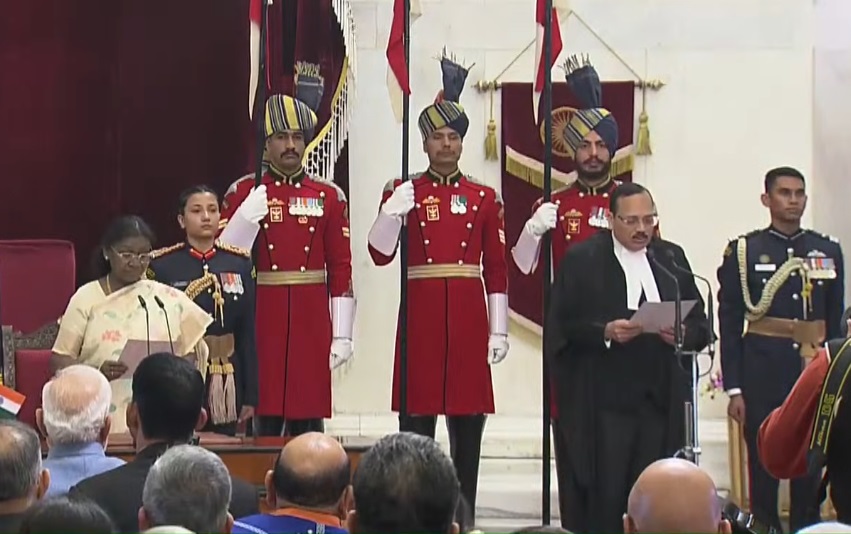
Justice Surya Kant was sworn in as Chief Justice of India (CJI) by President Droupadi Murmu on Monday at a ceremony conducted at Rashtrapati Bhavan in the national capital. In a major break from recent precedent, CJI Kant took the oath in Hindi, using the name of God.
The ceremony at Rashtrapati Bhavan was attended by Prime Minister Narendra Modi, Vice President C.P. Radhakrishnan, Union ministers, Haryana Chief Minister Naib Singh Saini, Supreme Court judges, and Chief Justices and judges from Bhutan, Kenya, Malaysia, Brazil, Mauritius, Nepal, and Sri Lanka.
Justice Kant, the 53rd Chief Justice of India, will serve for approximately 14 months before leaving office on February 9, 2027.
On October 30, the Centre cleared the appointment of Justice Kant to the highest judicial office of the country after then CJI Bhushan R Gavai had recommended him as his successor.
“In exercise of the powers conferred by clause (2) of Article 124 of the Constitution of India, the President is pleased to appoint Shri Justice Surya Kant, Judge of the Supreme Court of India, to be the Chief Justice of India with effect from November 24, 2025,” the Union Law and Justice Ministry had said in its notification.
Justice Surya Kant was born on February 10, 1962, in a middle-class family in Haryana. He graduated from Government Post Graduate College, Hisar, in 1981, and received his law degree from Maharishi Dayanand University, Rohtak in 1984.
He began his legal career in Hisar in 1984, then relocated to Chandigarh the following year to practice before the Punjab and Haryana High Court.
He has handled a wide range of constitutional, service, and civil cases throughout the years, representing universities, boards, corporations, banks, and even the High Court.
On July 7, 2000, he was named the youngest attorney General of Haryana and promoted to senior attorney in March 2001. He was elevated as a permanent judge of the Punjab and Haryana High Court on January 9, 2004.
Justice Kant went on to serve as Chief Justice of the Himachal Pradesh High Court from October 5, 2018, until his appointment to the Supreme Court on May 24, 2019. He has also worked for several judicial and legal service institutes.
He was a member of the Governing Body of the National Legal Services Authority (NALSA) for two consecutive terms from 2007 to 2011 and currently serves on many committees of the Indian Law Institute, a recognized institution under the Supreme Court of India. Since November 2024, he has served as Chairman of the Supreme Court Legal Services Committee.
Source: IANS