


 Finance
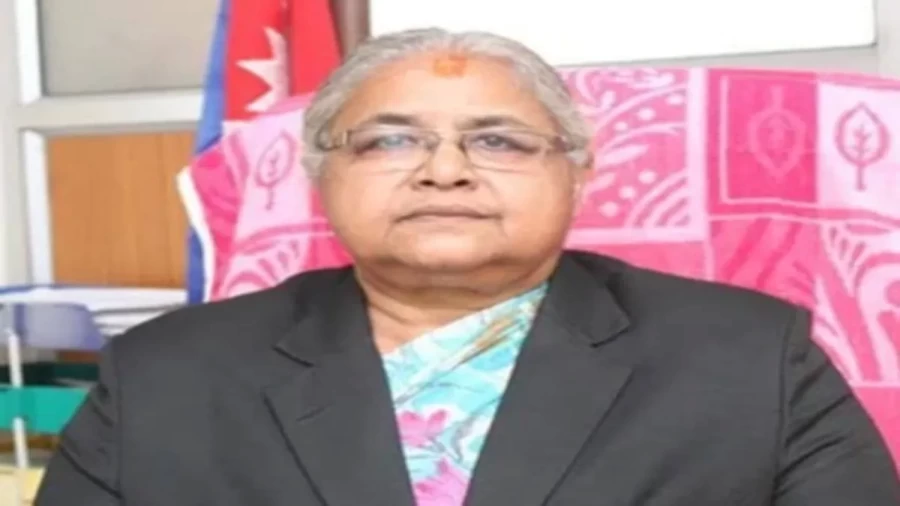
Sushila Karki, 73, was sworn in as Nepal’s interim Prime Minister late Friday evening, becoming the Himalayan nation’s first female prime minister.
Karki, the country’s first woman Chief Justice, was sworn in by President Ram Chandra Poudel, who spent the day consulting with Gen-Z protest leaders, constitutional experts, and the army chief.
Following the fall of KP Sharma-Oli’s administration during the violent Gen-Z protests on Monday, Karki was among the activists who took to the streets to denounce Oli’s authority.
Discussions with Gen-Z protestors and other stakeholders dragged on over whether the House of Representatives, the lower house, should be dissolved before or after the new Prime Minister is sworn in.
Despite other non-political candidates being proposed as alternatives, Gen-Z demonstrators agreed on Karki’s name, paving the door for her appointment as Prime Minister.
There is no constitutional provision that allows someone who is not a member of the House of Representatives to hold the position. Karki was appointed based on the “principle of necessity”.
According to Article 76 of Nepal’s Constitution, only a member of the House of Representatives can be Prime Minister. This criterion disqualifies Karki because even members of the National Assembly, the upper house of Parliament, are forbidden from holding the position.
Similarly, Article 132 (2) of the Constitution prohibits her from becoming Prime Minister. It stipulates that no person who has previously held the position of Chief Justice or Judge of the Supreme Court is eligible for nomination to any government post, unless otherwise allowed by the Constitution.
“She was appointed as Prime Minister based on the principle of necessity, a system practiced in Nepal time and again since the 1950 revolution,” said Bipin Adhikari, a constitutional lawyer. “But the principle of necessity is essentially not the rule of law. If we abandon the Constitution under one pretext or another, a habit develops of violating it, which may bring more trouble in the future,” he stated.
However, the expert noted that Karki might be trusted with the post because of her track record of upholding the Constitution as Justice and Chief Justice of the Supreme Court, as long as the arrangement is temporary and power is turned over to an elected administration when new elections are held.
Karki’s appointment as Prime Minister has received widespread praise throughout Nepal.
Former Chief Justice Kalyan Shrestha, who preceded Karki in 2016, told IANS that he trusted her integrity and capability. “I cannot judge her quality as a political leader, but from the judicial point of view, I have seen her leadership and she can be relied upon,” Shrestha said.
Former Prime Minister Baburam Bhattarai has also welcomed Karki’s appointment. “It is very positive and appropriate that the youths of Gen Z, who are prepared to lead a new Nepal, have recommended former Chief Justice and a capable, clean figure, Sushila Karki, to lead the interim government. She must be given full national cooperation and support. From our side as well, we extend full support and advance congratulations to her,” he said in a press statement.
Adhikari, the constitutional lawyer, praised her “integrity” and “capability”, but raised concerns about her ability to coordinate among stakeholders in the current context of uncertainty. He stressed that, in addition to holding elections within the stipulated timeframe, her government must also prosecute those responsible for the killing of young protestors and bring those involved in vandalism and arson to justice under criminal law.
According to a local media report quoting Nepal Police, as many as 51 people, including some security personnel, have been confirmed killed during the Gen-Z protests, which also caused large-scale destruction of public and private property, including businesses. “Specific measures should also be taken to address the demands of Gen-Z protestors related to corruption and good governance,” Adhikari added.
The newly appointed Prime Minister was born in 1952 to a middle-class family in Morang District’s Biratnagar, eastern Nepal. At a time when few girls attended school, her parents encouraged her to pursue an education.
Karki hailed from a political background; her father, inspired by Nepal’s first elected Prime Minister, B P Koirala, joined the Nepali Congress. Karki received a Bachelor of Laws (LLB) from Tribhuvan University in 1972 and a Master of Political Science from Banaras Hindu University in Varanasi, India, in 1975. After finishing her studies, she started her law practice in Biratnagar in 1979.
She became a senior advocate in 2007. In 2009, she was appointed an ad-hoc judge in the Supreme Court and was promoted to permanent judge in November 2010. In April 2016, she was appointed Chief Justice of the Supreme Court.
While serving as Chief Justice, Karki issued a major verdict in January 2017 ousting the then-powerful anti-corruption chief Lok Man Singh Karki, who was accused of terrorizing politicians, bureaucrats, and businesses by abusing his authority.
Her attitude on another contentious case, however, generated outrage when her decision on the nomination of a police chief went against the coalition government led by the Nepali Congress and CPN (Maoist Centre), prompting parliamentarians to file an impeachment resolution. She was briefly suspended before the Supreme Court overturned the impeachment and reinstalled her as Chief Justice.
In 2012, as a Supreme Court justice, she gave the sentence convicting then-minister Jaya Prakash Gupta on corruption allegations.
Durga Subedi, Karki’s spouse, was a Nepali Congress official who participated in Nepal’s first-ever plane hijacking in 1973 to support the party’s military insurgency against the dictatorial Panchayat system. The Royal Nepal Airlines plane was targeted when reports surfaced that it was carrying a substantial amount of cash.
Source: IANS