
 Finance
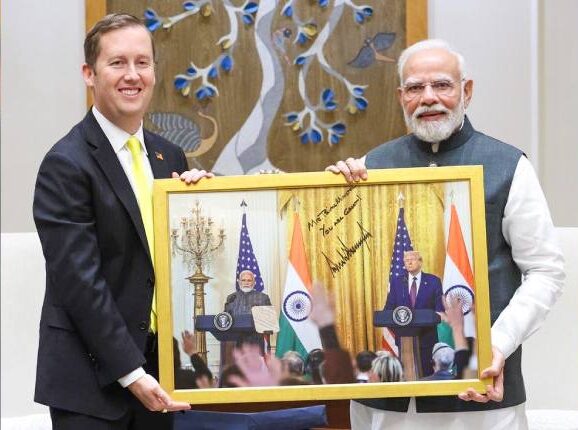
Sergio Gor, the 38-year-old Donald Trump confidant just approved as the United States’ youngest-ever ambassador to India, has already injected new energy into the world’s most important bilateral relationship in a frenzied six-day period leading up to his formal tenure.
Arriving from Washington on October 9 with Deputy Secretary for Management and Resources Michael J Rigas, Gor’s schedule – concluding in a “incredible” evening tete-e-tete with Prime Minister Narendra Modi – highlights a purposeful urgency to rebalance US-India relations in the midst of global uncertainty.
Gor, who received Senate confirmation on October 8 as part of a large group of 107 nominees, wasted no time.
His day included high-stakes huddles, a fruitful discussion with Foreign Secretary Vikram Misri about the Comprehensive Global Strategic Partnership’s shared priorities, a substantive dialogue with External Affairs Minister S Jaishankar, who praised the relationship’s “global significance” and wished Gor success in his dual role as Special Envoy for South and Central Asia, and a strategic briefing with National Security Advisor Ajit Doval.
Sergio Gor’s official remark read: “Good evening, it is a pleasure and delight to be here today. I flew from Washington to New Delhi early this morning, and we struck the ground running. We had an excellent sequence of discussions, including with Foreign Secretary Misri, External Affairs Minister Dr. Jaishankar, and National Security Advisor Doval. And we just had an amazing meeting with Prime Minister Modi, during which we covered bilateral matters such as military, trade, and technology. We also talked about the importance of vital minerals for both of our countries.
“The U.S. values its relationship with India and under the strong leadership of President Donald J. Trump and Prime Minister Modi, I am optimistic about the days ahead for both of our nations. President Trump considers Prime Minister Modi a great and personal friend. In fact, just before I left for New Delhi, they had an incredible phone call and that is something that will continue over the weeks and months ahead. Once again, it’s an honor to serve as President Donald Trump’s Ambassador to India and I look forward to this very important relationship and continuing to grow and deepen the relationship between our two nations. Thank you very much.”
The crescendo arrived at PM Modi’s residence, where discussions spanned defence interoperability, burgeoning trade pacts, technological convergence, and the linchpin of critical minerals — vital for both nations’ green energy ambitions and supply chain resilience.
Gor’s visit, though not for credential presentation, PM gifted Modi a signed photograph from their earlier White House summit, inscribed by President Donald J. Trump: “Mr Prime Minister, you are great.”
It symbolised the personal rapport Trump and PM Modi have cultivated since 2017’s “Howdy Modi” bonhomie.
“President Trump considers Prime Minister Modi a great and personal friend,” Gor affirmed post-meeting, recounting a pre-departure phone call between the leaders that portends sustained high-level engagement.
On X, Gor effused: “An honour to be with PM Narendra Modi this evening. Our relationship with India will only strengthen over the months ahead!”
PM Modi reciprocated: “Glad to receive Mr Sergio Gor… I’m confident that his tenure will further strengthen the India–US Comprehensive Global Strategic Partnership.”
This precocious diplomat’s rise is no coincidence. Gor, a Soviet-born genius who naturalized in America, rose to become Trump’s Director of the White House Presidential Personnel Office, vetting over 4,000 appointees with merciless efficiency—earning him the nickname “the most powerful man you’ve never heard of”.
His advising role with MAGA Inc. and stewardship of the Right for America PAC refined his ability to unify ideologies, which he now uses in diplomacy.
His confirmation emphasizes the India post’s strategic importance in Trump’s Asia strategy. Analytically, Gor’s arrival heralds a Trump 2.0 foreign policy that is laser-focused on transactional gains while remaining mindful of geopolitical imperatives. The US Embassy’s statement promises to “promote a safer, stronger, and more prosperous Indo-Pacific,” alluding to combating China’s ambitions through QUAD upgrades and iCET tech corridors. However, headwinds loom; Trump’s tariff threats and H1B visa increases may strain the $200 billion bilateral trade, disproportionately affecting Indian IT exports and the 4.5 million Indian-Americans.
Gor’s youth—contrasting the grizzled veterans of yore—signals agility in navigating these frictions, potentially brokering a “mini-deal” on minerals to sidestep broader protectionism. Optimism abounds, as Gor declared: “The US values its relationship with India… I am optimistic about the days ahead.”
In a period of flux, from Ukraine’s ripples to Taiwan’s tensions, Gor’s term has the potential to catalyze a “Modi-Trump 2.0” synergy, solidifying alliances while mitigating economic risks.
As Rigas and he depart on October 14, the envoy’s closing comments ring true: strengthening ties is more than just rhetoric; it is the foundation of a multipolar order.
Source: IANS