



 Finance
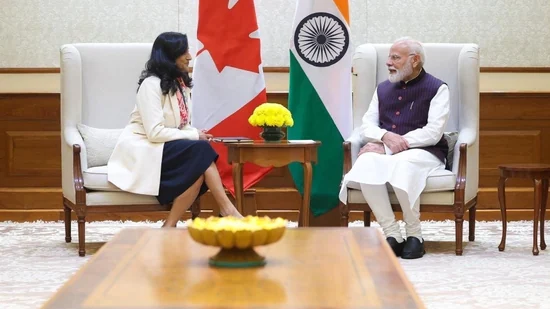
On Monday, Canadian foreign minister Anita Anand met with Prime Minister Narendra Modi and external affairs minister S Jaishankar to normalise relations strained by the killing of a Khalistani separatist two years ago.
The talks between the two foreign ministers were a follow-up to a meeting between Modi and his Canadian counterpart Mark Carney in June, when the two sides agreed on steps to restore stability to bilateral ties after a lengthy diplomatic spat, as well as several other official meetings in recent weeks.
Modi stated on social media that he and Anand talked about ways to improve cooperation in commerce, technology, energy, agriculture, and people-to-people exchanges for mutual benefit.
According to an Indian statement, Modi’s visit will help to revive the bilateral partnership. Modi recalled his June visit to Canada for the G7 Summit, where he had a “extremely productive meeting” with Carney. He also communicated his wishes to Carney, saying he was looking forward to their future encounters.
Anand stated on social media that India and Canada are building on the momentum of Carney’s meeting with Modi to elevate their connection while “maintaining our law enforcement and security dialogue and expanding our economic relationship”.
Anand is the first Canadian politician to visit India since former Prime politician Justin Trudeau claimed in September 2023 that Indian government agents were involved in the execution of Khalistani activist Hardeep Singh Nijjar, a statement New Delhi called as “absurd”. Anita Anand’s three-nation trip begins in India and will continue with stops in Singapore and China.
Jaishankar stated that both sides had developed an ambitious roadmap to promote cooperation in commerce, investment, agriculture, technology, civil nuclear collaboration, artificial intelligence, vital minerals, and energy. He noted he was holding talks with Anand after a “productive meeting” between the national security advisers of the two sides in New Delhi on September 18, another meeting of foreign ministry officials on September 19, and talks between the trade ministers on October 11.
“Had constructive discussions to restore and reinvigorate the mechanisms necessary to advance our partnership,” Jaishankar said on social media after the meeting. The two sides also agreed to “shepherd the process of rebuilding our cooperation so that it delivers on the expectation of our leaders and the interests of our people”, he added.
Anand noted at her meeting with Jaishankar that the recent meeting between Indian and Canadian officials on security and law enforcement was “very productive”. She said, “Both of our governments agree on the importance of those dialogues.”
People familiar with the matter said several meetings between Indian and Canadian security officials since late last year had helped close the gap on dealing with matters such as the activities of pro-Khalistan elements in Canada and concerns related to transnational organised criminal gangs. Canada recently added the Lawrence Bishnoi gang to its list of terrorist entities.
Measures outlined in the India-Canada joint statement or the new roadmap aim to build on recent steps to stabilise the relationship, such as the security dialogue and the posting of new high commissioners in each other’s capitals. The two sides will pursue a “constructive and balanced partnership grounded in respect for each other’s concerns and sensitivities”, the joint statement said in an apparent reference to India’s worries over pro-Khalistan activities.
Early economic cooperation initiatives will include ministerial-level discussions on bilateral trade and investment, as well as the resumption of the Canada-India CEO Forum to identify ways to facilitate increased trade and investment in clean technology, infrastructure, agriculture, and digital innovation.
Jaishankar and Anand agreed that a strong India-Canada bilateral relationship is essential amid “global economic uncertainty and rising geopolitical tensions”, the joint statement said. Reviving the partnership will boost enhanced economic cooperation and help “mitigate vulnerabilities arising from shifting global alliances” and “reinforce strategic stability in an increasingly complex international environment”, it said in a tacit reference to the churn created by the trade policies of the Donald Trump administration in the US.
Bilateral trade was worth $23.66 billion in 2024, and the two sides halted talks on a free trade agreement just before the relationship cratered due to the controversy over Nijjar’s killing.
According to the roadmap, the two countries will strengthen bilateral cooperation on climate action and environmental protection, as well as collaborate on renewable energy capacity and decarbonizing heavy industries. They will also deepen collaboration on clean and secure energy by re-establishing the Canada-India Ministerial Energy Dialogue and promoting two-way trade for LNG and LPG, as well as investments in oil and gas exploration and production.
The two sides will encourage communication between government and industry on how Canada’s mining experience may help India obtain essential minerals, as well as continue negotiations on civil nuclear cooperation. The plan encouraged negotiations between India’s Department of Atomic Energy and Canadian uranium suppliers about current and proposed new mines.
The two sides also agreed to expand their partnership in technology, namely artificial intelligence and digital infrastructure. Early steps will include relaunching the Joint Science and Technology Cooperation Committee and investigating possibilities for digital public infrastructure collaboration.
They also agreed to increase cooperation in education, tourism, and professional mobility through first efforts including as higher education and research collaboration, research partnerships in AI, cybersecurity, and fintech, and a revitalized Joint Working Group on Higher Education.
Source: HT