




 Finance
The Prime Minister, Shri Narendra Modi today shared an article penned by him, on the successful completion of 10 years of the Digital India initiative and its positive impact on India’s growth trajectory.
The Prime Minister wrote on X:
“As we mark #10YearsOfDigitalIndia, shared a few thoughts on LinkedIn, on how this initiative has positively impacted India’s growth trajectory.”


In his article, the Prime Minister wrote that while previous decades were filled with doubt over Indians’ ability to use technology, the government chose to place trust in the people. “While decades were spent doubting the ability of Indians to use technology, we changed this approach and trusted the ability of Indians to use technology,” he wrote.
He further emphasized that contrary to earlier beliefs that technology would widen social disparities, his government used it to bridge the gap. “While decades were spent thinking that use of technology will deepen the gap between the haves and the have-nots, we changed this mindset and used technology to eliminate the gap between the haves and the have-nots.”
According to the PM, the core idea behind Digital India was rooted in the belief that right intent and inclusive approaches can empower the marginalized. “When the intent is right, innovation empowers the less empowered. When the approach is inclusive, technology brings change in the lives of those on the margins,” he noted.
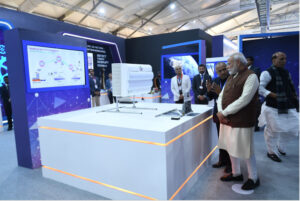
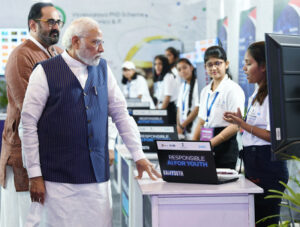
Foundation of a Movement
He stated that this belief laid the foundation for the Digital India mission, aimed at democratising access, building inclusive digital infrastructure, and creating opportunities for all.
Reflecting on the landscape in 2014, the Prime Minister pointed out that internet penetration was low, digital literacy minimal, and access to government services online was limited. “Many doubted whether a country as vast and diverse as India could truly go digital,” he said. Today, he affirmed, that doubt has been erased not just through data, but through real transformation in the lives of 140 crore Indians.
Bridging the Digital Divide
From 25 crore internet connections in 2014, the country now has over 97 crore. The expansion of Optical Fibre Cable has reached over 42 lakh kilometres—11 times the distance between Earth and the Moon—connecting even the remotest villages.
Highlighting infrastructure milestones, the PM mentioned India’s rapid 5G rollout, with 4.81 lakh base stations set up in just two years, even reaching strategic areas like Galwan, Siachen, and Ladakh.
Platforms like
India Stack have become the digital backbone of the country, enabling services such as UPI, which now handles more than 100 billion transactions annually. India accounts for nearly half of all real-time digital transactions globally.
Direct Benefit Transfer (DBT) has revolutionised welfare delivery, with ₹44 lakh crore transferred directly to beneficiaries, and savings of ₹3.48 lakh crore by eliminating middlemen. Schemes like
SVAMITVA have provided over 2.4 crore property cards and mapped 6.47 lakh villages.
Empowering Entrepreneurs and MSMEs
India’s digital transformation is also benefiting MSMEs and small entrepreneurs. Platforms like
ONDC (Open etwork for Digital Commerce) and
GeM (Government e-Marketplace) are unlocking new markets.
“Imagine this,” the PM wrote, “You apply for a Mudra loan online. Your creditworthiness is assessed through an account aggregator framework. You get your loan and start your venture. You register on GeM, supply to schools and hospitals, and then scale up via ONDC.”
ONDC recently surpassed 200 million transactions, with the last 100 million recorded in just six months. From Banarasi weavers to bamboo artisans in Nagaland, sellers are reaching customers nationwide without intermediaries.
Digital Public Infrastructure: India’s Global Contribution
India’s Digital Public Infrastructure—comprising Aadhaar, CoWIN, DigiLocker, FASTag, PM-WANI, and One Nation One Subscription—is now being studied and adopted globally. CoWIN enabled the world’s largest vaccination drive with 220 crore QR-code verifiable certificates. DigiLocker now serves 54 crore users with over 775 crore documents.
Through its G20 Presidency, India launched the Global DPI Repository and a $25 million Social Impact Fund to support digital infrastructure adoption in Africa and South Asia.
Startups and AI: The Next Digital Frontier
India ranks among the top three startup ecosystems globally, with over 1.8 lakh startups. The PM called this more than a startup movement—it is a
Tech renaissance
He highlighted India’s leadership in AI, noting strong talent concentration and the launch of the $1.2 billion
India AI Mission, which offers access to 34,000 GPUs at under $1/GPU hour, making India the most affordable compute destination.
India is also promoting responsible AI, with the
New Delhi Declaration on AI and the establishment of AI Centres of Excellence across the country.
Looking Ahead
Calling the next decade “even more transformative,” the Prime Minister wrote, “We are moving from digital governance to global digital leadership, from India-first to India-for-the-world.”
Digital India, he said, is no longer just a government program—it has become a people’s movement, central to
Aatmanirbhar Bharat and making India a trusted innovation partner globally.
“To all innovators, entrepreneurs, and dreamers: the world is looking at India for the next digital breakthrough,” he concluded.
“Let us build what empowers. Let us solve what truly matters. Let us lead with technology that unites, includes, and uplifts.”