


 Finance
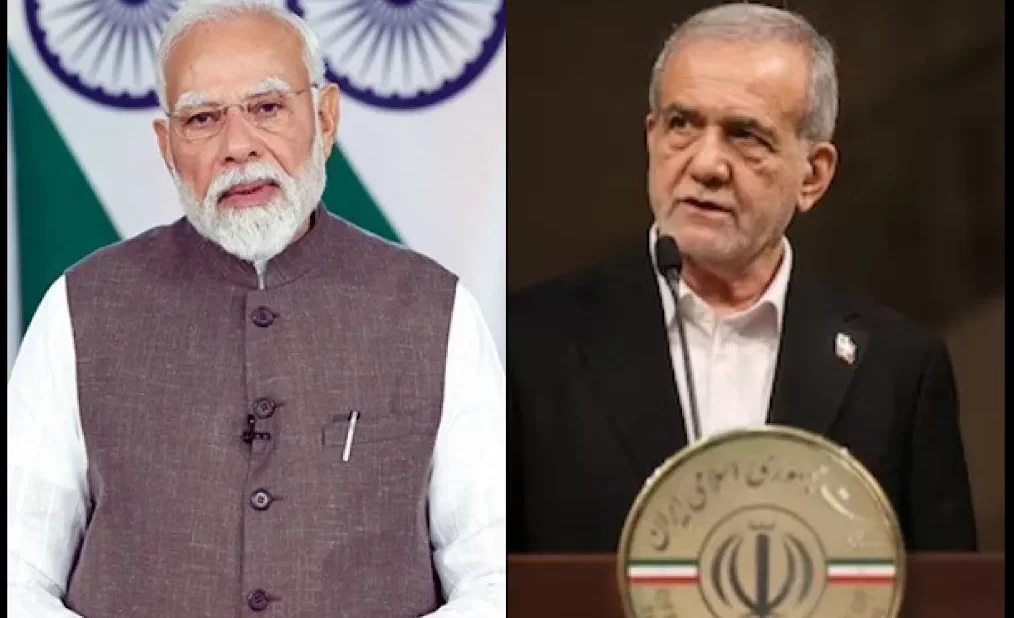
Hours after President Donald Trump announced that US missiles had “obliterated” Iran’s three main nuclear installations, Tehran reached out to Delhi, with President Masoud Pezeshkian contacting Prime Minister Narendra Modi on Sunday.
Modi expressed “deep concern at the recent escalations” and underlined India’s urge for “dialogue and diplomacy” in a post on X.
“Spoke with President of Iran @drpezeshkian. We discussed in detail about the current situation. Expressed deep concern at the recent escalations. Reiterated our call for immediate de-escalation, dialogue and diplomacy as the way forward and for early restoration of regional peace, security and stability,” Modi said.
This was Modi’s first call to Pezeshkian since the war began. Israel has communicated with India; Prime Minister Benjamin Netanyahu spoke with Modi, and Israel’s Foreign Minister Gideon Sa’ar spoke with External Affairs Minister S Jaishankar over the last ten days. While Iran’s Foreign Minister Seyed Abbas Aragchi had communicated with Jaishankar, this was a higher-level approach from Tehran.
According to a statement from the Prime Minister’s Office, Pezeshkian briefed Modi “in detail” and “shared his perspective on the current situation in the region, especially the ongoing conflict between Iran and Israel.”
“PM expressed India’s deep concern at the recent escalations. PM conveyed that India was on the side of peace and humanity. In this context, PM emphasised the need for immediate de-escalation, dialogue and diplomacy as the way forward. He reiterated India’s support for early restoration of regional peace, security and stability,” the PMO said.
“Prime Minister thanked President Pezeshkian for the continued support being extended for safe return and repatriation of the Indian community,” it said. “The two leaders reiterated shared commitment to continue to work for strengthening bilateral cooperation in different areas including trade and economic cooperation, science & technology and people-to-people ties,” it said, adding that they agreed to remain in touch.
Modi met Pezeshkian in October last year, on the margins of the 16th BRICS conference in Kazan, Russia, their first encounter since the latter became President in July.
India finds itself in a tricky position in the Iran-Israel dispute since it has critical interests in both nations.
India and Iran have been collaborating on the Chabahar port project, and both countries have similar concerns about Pakistan and Afghanistan. Their common worries about the treatment of minorities in these two neighboring countries have brought them together. They have also collaborated on the International North-South Transportation Corridor. Both the Chabahar port and the INSTC are thought to be critical to improving regional connectivity and economic cooperation.
Iran and India also collaborated at the Shanghai Cooperation Organisation conference, with Delhi facilitating Tehran’s participation in the body. India also played a role in Iran’s admission to the BRICS grouping, and the two countries have frequently exchanged views on China and Russia, particularly since Beijing has made a strong outreach and expanded its influence in Iran.
India also has a strategic security and defence alliance with Israel.
Source: IE