



 Finance
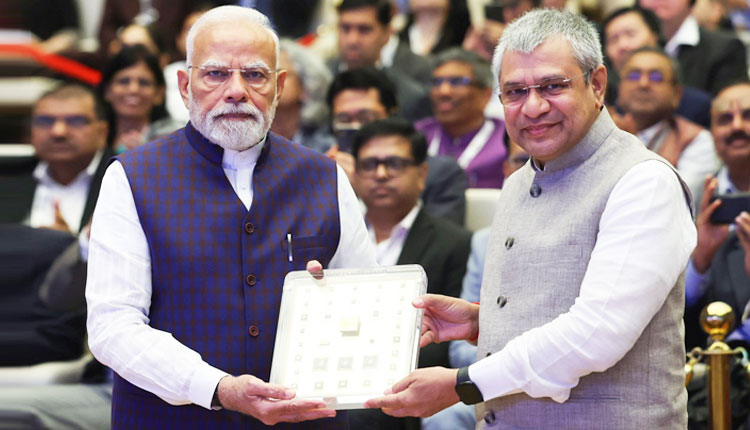
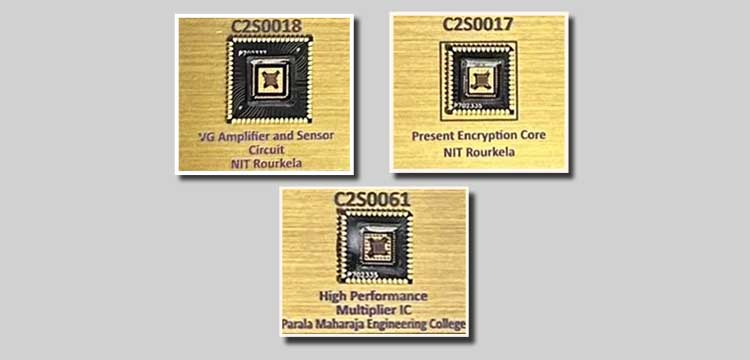
Union Minister for Electronics and Information Technology, Ashwini Vaishnaw, presented three semiconductor chips manufactured in Odisha to Prime Minister Narendra Modi during the inauguration of Semicon India 2025, held in New Delhi on Tuesday.
The National Institute of Technology (NIT), Rourkela, designed two of the chips’ “Made in India” semiconductor components, while Parala Maharaja Engineering College, Berhampur, created the third. While Parala Maharaja Engineering College developed the High Performance Multiplier IC (C2S0061), NIT Rourkela developed the VG Amplifier and Sensor Circuit (C2S0018) and the Present Encryption Core (C2S0017).
Prime Minister Modi spoke at the conference, highlighting India’s growing prominence in the world of semiconductors and highlighting the country’s willingness to play a significant role in the trillion-dollar chip sector.
“Since 2021, investments totaling $18 billion have been approved across 10 semiconductor projects. The world trusts India, believes in India, and is prepared to build the semiconductor future with India,” the Prime Minister said. He underlined that while the previous century was shaped by oil, the future will be defined by semiconductor chips.
PM Modi also noted the rapid growth of the global semiconductor market, which has already reached a valuation of $600 billion and is expected to surpass the $1 trillion mark soon, with India positioned as a significant player in this expanding sector.
Union Minister Ashwini Vaishnaw took to the social media platform X to celebrate the milestone, stating, “From 7.8% GDP growth to a growing semiconductor ecosystem with the first ‘Made in India’ chips — Bharat stands as a lighthouse of stability.”
Chief Minister Mohan Charan Majhi also congratulated Parala Maharaja Engineering College for its contribution. “I warmly congratulate PMEC Berhampur for developing the High Performance Multiplier IC C2S0061 — a proud part of this achievement,” CM Majhi said.
He also inaugurated the Odisha Pavilion at the event, highlighting the state’s potential as a forthcoming hub for semiconductor and electronics innovation, supported by progressive policies and investment-ready infrastructure.
Deputy Chief Minister Kanak Vardhan Singh Deo, in a post on X, described the event as “a defining moment in India’s technological renaissance.” He praised the unveiling of the nation’s first fully indigenous semiconductor chip, the Vikram processor, calling it a significant leap toward strategic autonomy and economic resilience.
Union Minister for Electronics and Information Technology, Ashwini Vaishnaw, presented three semiconductor chips manufactured in Odisha to Prime Minister Narendra Modi during the inauguration of Semicon India 2025, held in New Delhi on Tuesday.