


 Finance
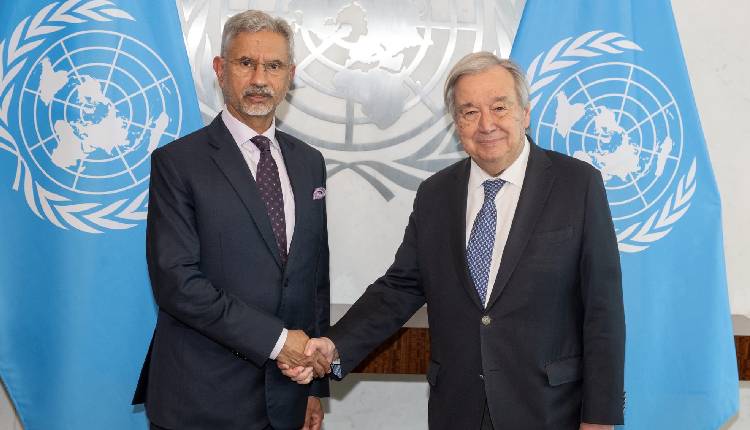
External Affairs Minister S. Jaishankar met with UN Secretary-General Antonio Guterres in New York, where the two discussed key global developments such as the conflicts in West Asia, Ukraine, and Sudan, as India officially launched its campaign for a non-permanent seat on the United Nations Security Council (UNSC) for the 2028-2029 term.
The high-level meeting took place on the backdrop of India’s UNSC campaign launch at the UN Headquarters, signaling the start of New Delhi’s diplomatic outreach to garner support from UN member states ahead of next year’s election.
Sharing details of the meeting on X, Jaishankar wrote, “Glad to meet @antonioguterres, Secretary General of the @UN in New York today. Discussed global developments, including of West Asia, Ukraine and Sudan. Also recognised the strength of India-UN cooperation.”
The discussions focused on pressing international crises and the continued cooperation between India and the United Nations on a range of global issues.
Earlier in the day, EAM Jaishankar formally announced India’s campaign for the Security Council, outlining a six-point strategy centered on SHANTI — Securing Holistic Advancement through Norms, Trust, and Integrity.
Addressing diplomats and delegates from around the world, he stated that India would serve as the Global South’s voice on the Security Council, emphasizing the country’s track record of assisting developing countries, contributing to UN peacekeeping operations, and working to strengthen multilateral institutions.
India’s SHANTI framework identifies six key priorities for its UNSC effort. These include strengthening the voice of the Global South in international peace and security, advancing a reformed multilateral system that is democratic, representative, and effective, creating a future-ready peacekeeping architecture equipped with modern technology, promoting a human-centric approach to artificial intelligence, supporting a free, open, and rules-based maritime order in accordance with international law, and intensifying global efforts to counterterrorism.
Jaishankar stated that India’s approach would be guided by conversation, cooperation, and efforts to bridge gaps, while pushing reforms that reflect current global realities. He also emphasized India’s commitment to advancing the Women, Peace, and Security agenda and keeping peacekeeping missions focused on their primary goals.
India will compete for the Asia-Pacific non-permanent seat on the Security Council in next year’s UN General Assembly election for the term 2028-2029. If elected, this will be the country’s seventh term as a member of the 15-member Council.
New Delhi is pushing its long-standing demand for a permanent seat on a reconstituted UN Security Council while also seeking election to the non-permanent seat to ensure that its voice continues to affect deliberations about global peace and security.
Source: IANS