







 Finance
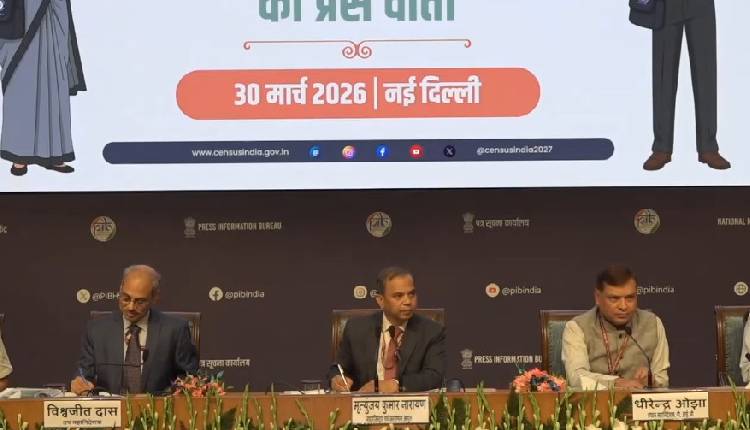
The Registrar General of India (RGI) said on Monday that preparations for the next Census are progressed, with fieldwork for the first phase, Houselisting and Housing Census (HLO), slated to begin in various states in April.
Mritunjay Kumar Narayan, Registrar General and Census Commissioner, told a news conference at the National Media Centre in New Delhi that Census-2027 will be performed in two parts — House Listing (HLO) and Population Enumeration (PE), with March 1, 2027 being the reference date.
The reference date for snow-bound regions such as Ladakh, Jammu and Kashmir, Himachal Pradesh, and Uttarakhand is October 1, 2026.
He explained the significance of the reference date, stating that it acts as a “snapshot” in time, enabling the collection of uniform and reliable demographic and socio-economic data across the country.
“The Census Reference Day is crucial because it acts as a ‘snapshot’ in time, providing a uniform point of reference to capture accurate demographic and socio-economic data across a vast and diverse population, ensuring data consistency and validity,” Narayan said.
Highlighting legal safeguards, Narayan said, “The Census Act includes an important provision, Section 15, stating that personal information supplied is considered strictly confidential. It cannot be disclosed under the RTI Act, used as evidence in court, or shared with any other organisations.”
He added that the role of states and union territories is central to the exercise.
“States and union territories play an essential role in this endeavour; their entire administrative system is engaged to carry out the fieldwork at the grassroots level. The last Census was carried out in 2011,” he said.
The Census Commissioner detailed that the process will comprise two phases — HLO and PE.
“The preparations for the Census are now at an advanced level, and in just a few days, the fieldwork for the initial phase — Houselisting and Housing Census — is about to begin in multiple states,” he said.
The Registrar General of India (RGI) said on Monday that preparations for the next Census are progressed, with fieldwork for the first phase, Houselisting and Housing Census (HLO), slated to begin in various states in April.
Mritunjay Kumar Narayan, Registrar General and Census Commissioner, told a news conference at the National Media Centre in New Delhi that Census-2027 will be performed in two parts — House Listing (HLO) and Population Enumeration (PE), with March 1, 2027 being the reference date.
The reference date for snow-bound regions such as Ladakh, Jammu and Kashmir, Himachal Pradesh, and Uttarakhand is October 1, 2026.
The Registrar General of India (RGI) said on Monday that preparations for the next Census are progressed, with fieldwork for the first phase, Houselisting and Housing Census (HLO), slated to begin in various states in April.
Mritunjay Kumar Narayan, Registrar General and Census Commissioner, told a news conference at the National Media Centre in New Delhi that Census-2027 will be performed in two parts — House Listing (HLO) and Population Enumeration (PE), with March 1, 2027 being the reference date.
The reference date for snow-bound regions such as Ladakh, Jammu and Kashmir, Himachal Pradesh, and Uttarakhand is October 1, 2026.
He explained the significance of the reference date, stating that it acts as a “snapshot” in time, enabling the collection of uniform and reliable demographic and socio-economic data across the country.
“The Census Reference Day is crucial because it acts as a ‘snapshot’ in time, providing a uniform point of reference to capture accurate demographic and socio-economic data across a vast and diverse population, ensuring data consistency and validity,” Narayan said.
Highlighting legal safeguards, Narayan said, “The Census Act includes an important provision, Section 15, stating that personal information supplied is considered strictly confidential. It cannot be disclosed under the RTI Act, used as evidence in court, or shared with any other organisations.”
He added that the role of states and union territories is central to the exercise.
“States and union territories play an essential role in this endeavour; their entire administrative system is engaged to carry out the fieldwork at the grassroots level. The last Census was carried out in 2011,” he said.
The Census Commissioner detailed that the process will comprise two phases — HLO and PE.
“The preparations for the Census are now at an advanced level, and in just a few days, the fieldwork for the initial phase — Houselisting and Housing Census — is about to begin in multiple states,” he said.
The HLO will entail listing all buildings and structures and gathering data on housing conditions, amenities, and assets. It will also comprise geotagging buildings and issuing each structure with a unique identification number.
This phase is ascheduled to take place between April and September 2026.
According to Narayan, the implementation of a digital system will enable residents to self-enumerate by directly entering their information, eliminating reliance on enumerators and making the process more efficient.
He stated that this self-enumeration opportunity will be open for 15 days prior to the 30-day houselisting period.
Providing a timeframe, he claimed that 11 states and union territories will begin the HLO process in April 2026, nine in May, three in June, two in July, and two in August.
The second phase, Population Enumeration, would collect individual data such as age, gender, occupation, literacy, and caste.
Narayan further stated that the Union Cabinet had allocated a total budget of Rs 11,718.24 crore for the Census in December 2025. Administrative boundaries were fixed on January 1, 2026, and a pre-test of the first phase was held throughout all states and union territories in November of last year.
He stated that over 80,000 enumerator training batches had been organized throughout the country for both phases of the Census.
Narayan emphasized data protection, stating that robust measures have been implemented to assure end-to-end security throughout the process, and that the data centers involved have been recognized as Critical Information Infrastructure.
Source: IANS