






 Finance
Malaria is caused by the parasite Plasmodium. There are five species of Plasmodium that infect humans.
Plasmodium vivax Plasmodium falciparum
Plasmodium Malariae
Plasmodium ovale
Plasmodium knowlesi is less frequent.
Plasmodium falciparum infection is the most severe, resulting in mortality in up to one in every ten cases. Pregnant women and children are particularly at danger. Other varieties of malaria are less severe, but can still be fatal. Malaria, on the other hand, is preventable and curable if detected early.
How malaria is spread
The parasite is transmitted to humans through the bite of infected female Anopheles mosquitoes.
Parasites multiply in an infected person’s liver and bloodstream. When an infected person is bitten by another mosquito, the parasite may be transmitted. The mosquito is then infected for the rest of its life and can infect additional individuals by biting them.
Malaria can occasionally be transferred through blood transfusions. Find out more about malaria screening before donating. Malaria can be passed from mother to unborn child.
Malaria is found in most tropical and subtropical regions of the world, including:
- Africa
- Central and South America
- Asia, including Southeast Asia
- Papua New Guinea
- western Pacific islands.
Australia has not had local malaria spread since 1981. However, the Anopheles mosquitoes that can carry malaria are still present in northern Australia, and several hundred cases occur each year in travellers entering Australia from other countries.
Tourists often get severe illness because they have had no previous exposure to malaria and no resistance to the disease.
Signs and symptoms of malaria
Symptoms can be mild or life-threatening.
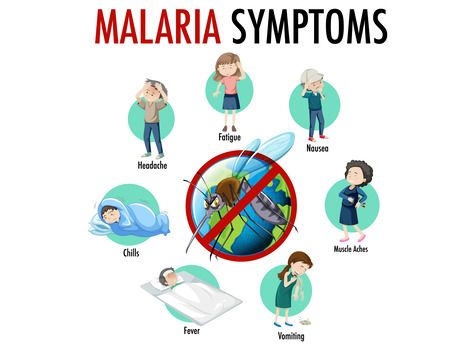
Symptoms of malaria may include:
- fever, which may come and go every 2-3 days, or may be constant
- chills
- profuse sweating
- malaise (feeling of unwellness)
- muscle and joint pain
- headache
- confusion
- nausea
- loss of appetite
- diarrhoea
- abdominal pain
- cough
- anemia.
Plasmodium falciparum may cause kidney, liver and/or lung failure, or cerebral malaria, a serious complication resulting from inflammation of the brain that may cause coma.
Diagnosis of malaria
Diagnosis is made by a blood test – sometimes it is necessary to repeat the test as the parasites can be difficult to detect.
Incubation period
(time between becoming infected and developing symptoms)
Varies with the type:
- P. falciparum: 9 to 14 days
- P. vivax: 12 to 18 days but some strains may have an incubation period of 8 to 10 months or longer
- P. ovale: 12 to 18 days
- P. malariae: 18 to 40 days
- P. knowlesi 9 to 12 days.
These periods are approximate and may be longer if the person has been taking drugs taken to prevent infection.
If an infection is not fully treated with anti-malarial medicine, it can relapse months or years later, when parasites emerge from the liver back into the bloodstream.
Infectious period
(time during which an infected person can infect others)
Direct person-to-person spread does not occur.
A person remains infectious to mosquitoes as long as the parasites are present in the blood. This may be several years if adequate treatment is not given. Parasites disappear from the blood within a few days of commencing appropriate treatment. Mosquitoes remain infected for life.
Treatment for malaria
Specific antimalarial treatment is available and must always be started as soon as malaria is diagnosed. There is increasing resistance to currently available drugs and treatment should be carried out by an infectious diseases specialist or other expert in the field.
Prevention of malaria
- Travellers to areas with malaria are usually advised to take preventative anti-malarial drugs and protect themselves from mosquito bites.
- Exclusion from childcare, preschool, school or work is not necessary. Cases should avoid being bitten by mosquitoes while they are unwell.
- Personal protection and the environmental management of mosquitoes are important in preventing illness.